
Texture leads every real 2026 dessert conversation, with a return to recognizable ingredients and smaller, fruit-forward single servings close behind. Industry forecasting from Puratos backs that read, and we see the same pull toward honest, well-made treats in our own small-batch work at London's Sweets. Below, we cover the viral formats, flavour breakouts, texture techniques, and market signals worth knowing, plus what this looks like applied to a real cake pop order.
TL;DR:
- Repeat purchases depend on texture as much as flavor, so test crisp shells, creamy centers, and moisture migration after a full day of storage.
- Small makers can borrow a viral dessert’s crisp shell or hidden filling without copying its format, then adapt that technique to products they already make.
- In Canada, matcha appeared on menus roughly 87% more often year over year, while shoppers also showed growing interest in locally sourced ingredients.
- For gluten free, dairy free, or nut free orders, confirm ingredients and cross contact directly with the maker because kitchen practices vary by batch.
Table of Contents
- 1. Viral formats and visual-first desserts to watch
- 2. Flavour and ingredient trends for 2026
- 3. Texture and format innovation: the why and the how
- 4. Market signals and consumer behaviour that shape 2026 dessert demand
- 5. Practical examples: how a small cake-pop maker could apply 2026 trends
- 6. Influence of technology and automation on dessert creation
- 7. Emerging dietary requirements and allergen-free dessert trends
- 8. Regional and global cultural influences shaping 2026 dessert trends
- 9. Role of social media platforms in popularizing new dessert trends
- FAQ
- Sources
1. Viral formats and visual-first desserts to watch
Short-form video has reshaped which desserts get made in the first place. A format now has to photograph well, reveal something when cut or bitten, and finish in under fifteen seconds of footage, and the winners of 2026 share a few traits: layered construction, a snap or crackle, and a colour or cross-section that reads clearly on a small screen.
- Dubai chocolate and pistachio-knafeh hybrids: the shredded pastry crunch against melted chocolate and pistachio filling remains one of the strongest texture contrasts going viral, and bakeries are stretching the format into bars, cookies, and layered cups.
- Mochi donuts: the chewy-crisp combination of glutinous rice dough and a fried exterior keeps this format in rotation, especially in multicolour glaze drops that photograph as a ring of distinct textures.
- Ube and other purple-hued desserts: colour-forward fillings built around ube, taro, or blueberry give a dramatic cross-section cut without relying on artificial dye.
- Freeze-dried sweets: freeze-dried chocolate and candy deliver a visual "puff" and a novel crunch that performs strongly on short-form platforms, according to FoodNavigator's texture reporting.
- Cloud and airy bakes: aerated mousses, whipped toppings, and meringue-style textures lean into the pale, minimal aesthetic that dominates current food styling.
Most of these formats scale down well for small producers. A home-based or small-batch maker can usually borrow the texture idea, a crisp shell, a hidden filling, a contrast cut, without replicating the exact viral product, which matters more for a single-serve treat than copying it stroke for stroke.
2. Flavour and ingredient trends for 2026
Flavour in 2026 is less about novelty for its own sake and more about brightness, heat, and honesty. Tangy and fruit-forward profiles continue to push past the standard chocolate-vanilla-caramel trio, especially in single-serve formats that can carry a sharper, more specific flavour without asking for a big commitment from the eater.
- Tart and fruit-forward notes: yuzu, passionfruit, mango, and cranberry show up in single-bite patisserie because a small portion can handle a bolder, tangier profile than a full-size slice.
- Sweet-and-spicy pairings: chipotle-chocolate, miso-caramel, and tahini notes bring a savoury or smoky edge that balances sugar without masking it.
- Heritage and "return to real" flavours: maple, butter-tart style notes, and brown butter are being reworked into more refined presentations rather than retired, reflecting what industry coverage of autumn bakery trends describes as heritage flavours reappearing in elevated formats.
- Functional cues: gut-health and fibre messaging increasingly rides alongside flavour claims rather than replacing them.
Puratos' Taste Tomorrow forecast names "tangy twist" as one of the top patisserie trends heading into 2026, which lines up with how often tart fruit shows up across the formats above. The throughline is simple: a smaller portion earns the right to a stronger, more specific flavour, and consumers increasingly read that specificity as quality rather than gimmick.
3. Texture and format innovation: the why and the how
Texture has moved from a secondary consideration to the main driver of whether someone buys a dessert again. According to Bakery and Snacks' 2026 texture trend reporting, contrast and mouthfeel now influence loyalty as much as flavour, and a texture failure, something gone soggy, gritty, or flat, causes people to quietly stop buying far more often than a flavour they merely disliked.
That reframes product development. A dessert that tastes fine but has one uniform texture throughout reads as plain, while one with two or three contrasting textures in a single bite reads as considered, even at a modest price point.
Practical techniques worth testing:
- Layer for contrast: pair a crisp or crunchy shell with a soft or creamy centre so each bite delivers a structural surprise.
- Add freeze-dried inclusions: freeze-dried fruit or chocolate pieces bring concentrated flavour and a novel crunch, though they need testing for moisture migration in anything stored longer than a day.
- Build crisp-shell, creamy-centre combinations: a thin shell that shatters against a soft filling is one of the most reliable contrast pairings across formats.
- Aerate where possible: whipped or aerated chocolate and mousse components add lightness that balances denser cake or pastry elements.
- Add an interactive element: a peel-back wrapper, a drizzle to break, or a shell to crack gives the eater a small moment of engagement before the first bite.
Pro Tip: Test mouthfeel across a full day of storage conditions, not just straight out of production, since moisture migration between layers is one of the most common causes of a texture that falls apart by the time it reaches the eater.
4. Market signals and consumer behaviour that shape 2026 dessert demand
Portion size and ingredient honesty are doing a lot of work in 2026 purchasing decisions. Shoppers are still buying sweet baked goods, but they favour smaller, premium portions over large ones, treating dessert as a deliberate choice rather than a routine one.
- Smaller, premium portions: Puratos identifies "perfect portion" as a top 2026 patisserie trend, with one-bite and single-serve formats letting makers charge a premium while lowering the commitment for the buyer.
- Matcha and provenance interest: Canadian consumer data shows matcha growing roughly 87% on menus over the prior year, alongside rising interest in buy-local provenance claims, according to Tastewise's Canada food trends report.
- Functional claims paired with simplicity: claims land best when paired with a short, recognizable ingredient list rather than standing alone.
Sugar and cocoa prices softened through 2026, though volumes are expected to stay above five-year averages, and demand for premium, artisanal chocolate continues regardless, per the FCC's 2026 sugar and confectionery report. For small makers, that means pricing can stay anchored to ingredient quality rather than constant adjustment, since the premium end of the market is holding steady even as input costs ease.
5. Practical examples: how a small cake-pop maker could apply 2026 trends
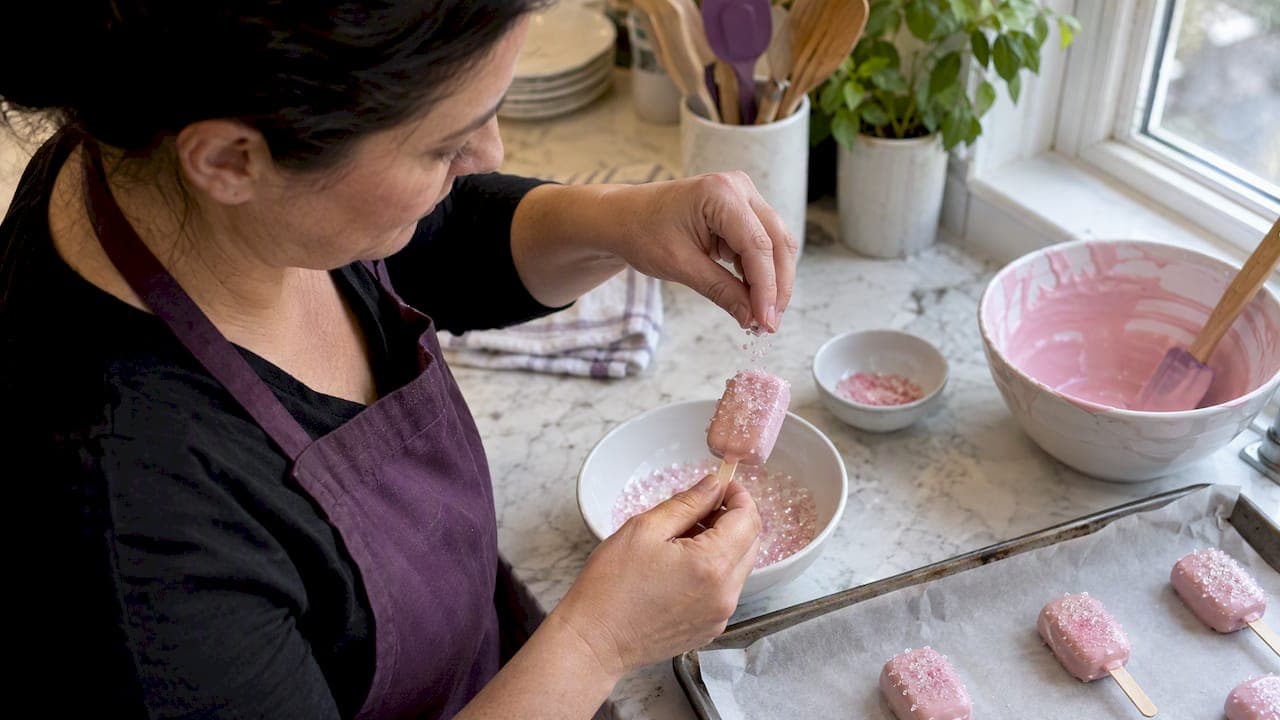
A rounded-rectangle cake pop is a natural fit for the single-serve, texture-forward direction 2026 favours. At London's Sweets, a tangy fruit filling idea could translate into a simple colour block finish in a bright fruit-tone shade, while a texture-contrast idea could show up as a hand-dipped coating finished with sugar crystals for a crisp, sparkling shell against the soft cake centre. A heritage-flavour request might pair a warm hand-dipped coating with a simple drizzle in a contrasting tone, echoing the brown-butter and maple palette gaining ground elsewhere.
We work from a home-based bakery in Dundas, Ontario, and every order is individually wrapped. Paid delivery can be requested within about 100 km of Dundas, though the exact address, timing, and fee are confirmed before we accept the order. Anyone interested in a custom design can reach out through our online ordering form to discuss colours and finishes.
6. Influence of technology and automation on dessert creation
Automation is changing production more than it is changing the dessert itself. Larger bakeries use automated tempering and portioning equipment to hit consistent texture results at scale, which is part of why texture consistency has become a benchmark consumers now expect even from smaller producers. Recipe formulation tools and ingredient databases also make it easier for bakers to model how a swap, say a different fat or a freeze-dried inclusion, will behave structurally before a single test batch goes in the oven.
For small-batch and home-based makers, the more relevant shift is simpler: better home equipment (precise thermometers, consistent dipping tools, reliable packaging) has narrowed the texture and finish gap between a home kitchen and a commercial one. That is part of why hand-dipped coatings, clean drizzle lines, and consistent sugar-crystal application are achievable outside a large facility, without needing industrial machinery to get a clean, repeatable result.
Social platforms themselves also function as a testing tool. Watching which cuts, colours, and textures get engagement gives smaller makers a low-cost way to see what resonates before committing to a full menu change, a kind of informal market research that used to require much larger budgets.

7. Emerging dietary requirements and allergen-free dessert trends
Dietary accommodation has moved from a niche request to a standard planning question for most dessert menus. Gluten-free, dairy-free, and nut-free requests remain the most common, and 2026's broader "return to real" mood pushes makers toward naturally allergen-friendly ingredients (fruit, dark chocolate, simple nut-free bases) rather than heavily processed substitute products.
Clean-label snacking brands are part of that same shift. NutroBlaze's seed-based snack blends, built around flax, sesame, and fennel with no added sugar, reflect the same consumer demand for recognizable ingredients and functional benefit that is reshaping dessert ingredient lists, even though the format itself sits outside traditional desserts.
For a custom dessert order, the practical takeaway is that allergen and dietary needs should always be confirmed directly with the maker rather than assumed from a menu description, since ingredient lists and cross-contact risk vary by kitchen and by batch.
8. Regional and global cultural influences shaping 2026 dessert trends
Many of 2026's breakout formats come from cross-pollination between culinary traditions rather than a single region's innovation. Dubai chocolate draws on Middle Eastern pastry technique, mochi donuts blend Japanese and North American formats, and ube desserts carry Filipino ingredient traditions into mainstream bakery cases. That blending is less about novelty tourism and more about makers borrowing proven texture and flavour combinations from wherever they originate.
Heritage flavour revivals follow a parallel local thread: maple and butter-tart notes reappearing in elevated formats reflect the same "return to real" instinct applied to regional ingredients rather than imported ones. The common pattern across both directions, global borrowing and local revival, is that authenticity and a clear ingredient story now matter as much as the flavour itself.
9. Role of social media platforms in popularizing new dessert trends
Short-form video did not just publicize 2026's dessert trends, it shaped which ones succeeded. A dessert now effectively needs a visual hook: a cross-section reveal, a drizzle pour, a shell crack, something that reads in a few seconds of footage. That requirement is a large part of why texture contrast and bold colour have become default design considerations rather than occasional flourishes.

Platforms also compress the usual discovery timeline. A format can go from a single creator's post to broad bakery adoption in weeks rather than the months or years that earlier trend cycles took, which pressures small makers to watch trends closely without necessarily chasing every one. The more durable approach, reflected across most of the formats and flavours covered above, is borrowing the underlying technique (contrast, colour, a clean reveal) and applying it to a maker's own existing strengths rather than copying a viral product outright.
FAQ
What are the trendiest desserts in 2026?
The trendiest desserts in 2026 combine strong texture contrast with fruit-forward or tangy flavours in smaller, single-serve formats. Formats like Dubai chocolate hybrids, mochi donuts, and freeze-dried inclusions lead because they deliver a visual and textural payoff in one bite, as outlined in Puratos' Taste Tomorrow forecast.
What is the most trending dessert right now?
Texture-forward, cut-and-reveal desserts, such as pistachio-knafeh chocolate bars and layered single-serve patisserie, are leading current trend conversations. Their appeal comes from a crisp-to-creamy contrast that photographs and films well, a factor Bakery and Snacks' texture research ties directly to repeat purchase.
What are the latest trends in desserts?
The latest dessert trends centre on texture mashups, a return to recognizable, less processed ingredients, and smaller premium portions that let makers charge more while asking less commitment from the buyer. Functional claims like fibre and gut-health benefits are increasingly paired with simple ingredient lists rather than standing on their own.
What are the trending desserts right now?
Trending desserts right now include Dubai chocolate hybrids, mochi donuts, ube-based bakes, and freeze-dried chocolate or candy, all built around strong texture contrast. Tangy, fruit-forward single-serve formats and heritage flavours like maple and brown butter are trending alongside them as part of the broader shift toward authentic, recognizable ingredients.
Can a small bakery realistically keep up with dessert trends?
A small or home-based bakery can usually adapt the underlying technique behind a trend, texture contrast, a bold finish, a fruit-forward flavour, without replicating a viral product exactly. At London's Sweets, that might mean applying a hand-dipped coating, a simple drizzle, or a colour-blocked finish to a custom cake pop order rather than chasing every new format.
Sources
- Taste Tomorrow: hottest patisserie trends
- Canada food trends
- Texture innovation: the future of confectionery
- 2026 food & beverage report: sugar and confectionery products