
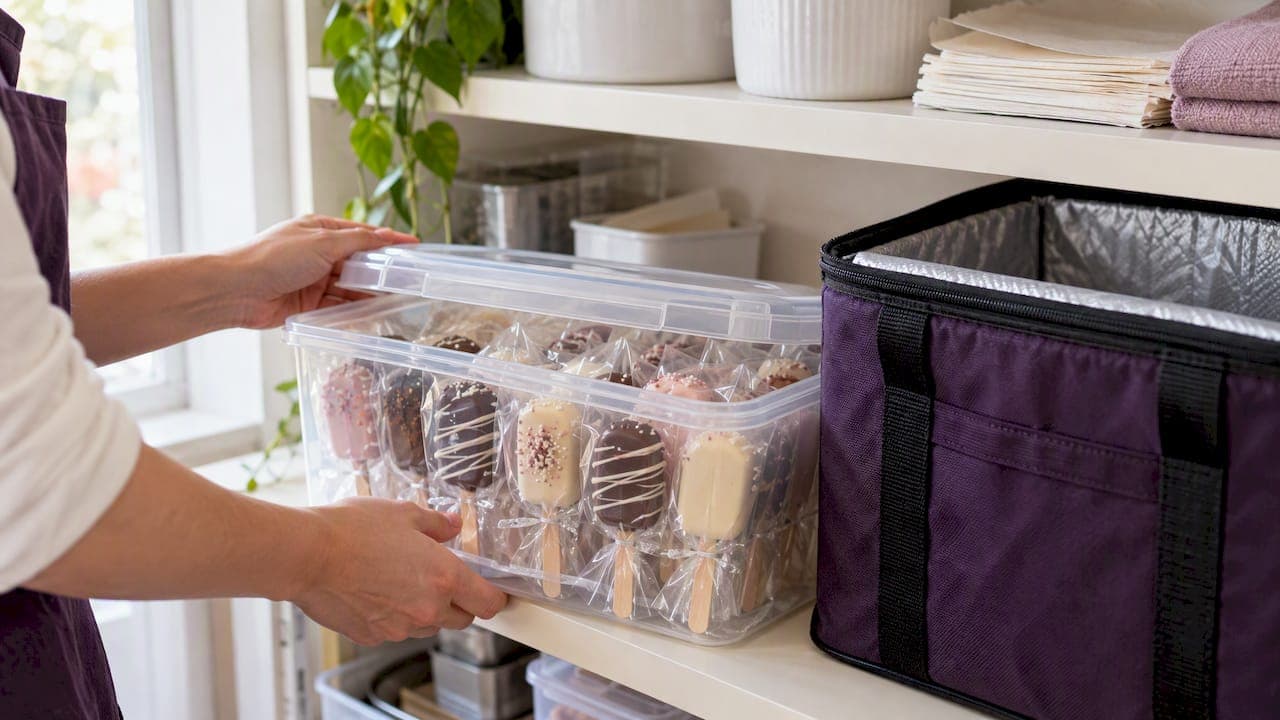
A fully decorated cake pop holds its best texture for about a day at room temperature, several days in the fridge, and a few months in the freezer, depending on the filling. Health Canada's safe handling guidance sets the real safety limit, though: anything sitting between 4°C and 60°C for more than two hours should be thrown out. Dairy fillings, buttercream, and ganache shorten every one of those windows.
TL;DR:
- Cake pops made with dairy fillings or perishable components should be eaten within three to four days refrigerated or frozen for up to six months to maintain safety and quality.
- Keeping cake pops individually wrapped, refrigerated, or frozen with proper timing and handling greatly reduces contamination risks and preserves texture.
- Avoid leaving room-temperature cake pops out for more than two hours, especially in warm or humid conditions, to prevent bacterial growth and spoilage.
- Decorations like delicate piped details or fresh fruit are best added after thawing frozen pops to prevent loss of shape and moisture issues.
- Signs of spoilage include mold, slimy surfaces, off smells, or sitting beyond recommended storage windows, requiring immediate disposal.
Table of Contents
- Room-temperature storage: how long cake pops last on the counter
- Refrigerated storage: how long cake pops keep in the fridge
- Freezing cake pops: how long, how to freeze, and how to thaw
- How fillings and finishing touches change how long cake pops last
- Getting cake pops ready for an event: timing, packaging, and transport
- Signs of spoilage and when to throw cake pops out
- London's Sweets: how we make, package, and deliver cake pops
- How humidity and temperature affect cake pop shelf life
- How the cake base itself affects shelf life
- Reviving cake pops that have gone a little stale
- How London's Sweets can help with your cake pop order
- FAQ
- Sources
Room-temperature storage: how long cake pops last on the counter
A cake pop made with a stable sugar or candy coating and no dairy filling usually tastes and looks its best within a day of dipping, maybe a little longer if the kitchen is cool and dry. That is a quality estimate, not a safety rule. The actual safety boundary comes from Health Canada's guidance, which states that cooked or prepared foods left between 4°C and 60°C for more than two hours should be discarded, since that range lets harmful bacteria multiply quickly.
This matters more for cake pops than people expect. The cake base itself was baked, but everything added after that, the coating, the drizzle, the sprinkles, never goes through another heat step. A CFIA survey of refrigerated baked desserts found that contamination risk in these products often comes from handling during decoration, not from the bake itself. A cake pop sitting out on a dessert table for a few hours at a summer party carries more risk than one served fresh from a cool kitchen.
A few habits keep counter-stored cake pops safer and better looking:
- Keep cake pops individually wrapped until serving to limit hand contact and air exposure.
- Store them somewhere cool, dry, and out of direct sunlight; a warm windowsill softens coating and filling fast.
- Set a clock, not a guess: treat two hours at room temperature as the outer edge, even at a party.
- Bring dairy-filled or buttercream-centred pops out last and keep the rest refrigerated until serving time.
Pro Tip: If you're serving cake pops outdoors in warm weather, keep the tray in a cooler box between rounds and only set out what guests will eat in the next hour.
Refrigerated storage: how long cake pops keep in the fridge
Refrigeration buys the most practical window for most home bakers and small sellers. Health Canada recommends consuming refrigerated leftovers within three to four days for both safety and quality, and that guidance applies cleanly to cake pops made with perishable fillings like buttercream, cream cheese, or ganache.
Three to four days is the number to plan around for anything refrigerated, whether you made cake pops yourself or picked them up from a bakery.
To keep refrigerated cake pops in good shape:
- Let coated pops set fully before placing them in the fridge, so the shell doesn't crack from condensation.
- Store them upright in a container with spacing between pieces to avoid smudged coating or transferred colour.
- Use a lid or wrap to cut down on moisture pulling in from the fridge air, which dulls a glossy shell.
- Keep dairy-based and shelf-stable pops in separate containers if you're storing a mixed batch.
- Pull pops out roughly 15 to 20 minutes before serving so the coating isn't cold and brittle and the cake inside softens back up.
Refrigeration slows bacterial growth but it can also make a hard coating sweat once it hits room air again, which is why that short rest before serving makes a real difference to texture.
Freezing cake pops: how long, how to freeze, and how to thaw
Freezing is the move for anyone making cake pops well ahead of an event. Health Canada notes that frozen leftovers stay the best quality for two to six months, with the exact window depending on the ingredients involved; a simple sugar-glazed pop holds up longer in the freezer than one filled with fresh cream or fruit.
Freezing cake pops well takes a few deliberate steps:
- Chill finished, fully set cake pops in the fridge for 15 to 20 minutes before freezing so the coating hardens first.
- Flash-freeze them upright and unwrapped on a tray for an hour so they don't stick together or to any packaging.
- Wrap each pop individually in plastic wrap or a small bag once firm, then pack them into an airtight container.
- Label the container with the freezing date so you're not guessing later.
- Thaw pops in the fridge overnight, then let them sit at room temperature for 15 to 20 minutes before serving to avoid condensation fogging the coating.
Pro Tip: Thaw cake pops in the fridge, not on the counter. A slow thaw limits the condensation that makes chocolate coating turn cloudy or spotted.
Some decorations don't survive a freeze-thaw cycle gracefully. Delicate piped details or fresh fruit garnishes can lose shape or weep moisture once thawed, so many bakers freeze the undecorated or simply coated pop and add final touches like drizzle or sprinkles after thawing.
How fillings and finishing touches change how long cake pops last
Not every cake pop ages at the same rate, and the filling matters more than most people assume.
- A plain cake and buttercream pop with a hard candy or chocolate shell is the most forgiving type, holding up well across the standard counter, fridge, and freezer windows.
- A cream cheese or dairy-based filling pushes the pop toward the shorter end of every storage window and makes refrigeration non-negotiable rather than optional.
- A ganache centre behaves similarly to dairy fillings since it's built on cream, and it softens faster at room temperature than a sugar-based coating.
- A fresh fruit addition, whether mixed into the cake or used as a garnish, shortens shelf life the most and should be treated as a same-day or next-day item.
The common thread across all of these is that nothing after the bake gets heat-treated again. A CFIA review of refrigerated ready-to-eat baked desserts points to post-bake decoration as a recurring contamination point, which is exactly the stage where cake pops pick up their coating, drizzle, and sprinkles. The more perishable the filling, the more that handling risk compounds, which is why small-batch sellers using dairy fillings often lean toward made-to-order timing rather than holding finished stock.
Getting cake pops ready for an event: timing, packaging, and transport
A little scheduling goes a long way toward cake pops that still look sharp when they arrive. For most fillings, finishing the coating and decoration the same day or the day before an event gives the best appearance. Fillings with dairy or cream hold up for roughly one to three days refrigerated before quality starts to slip, while anything needed further out is a candidate for freezing instead.
Packaging deserves the same attention as timing:
- Wrap each cake pop individually in a food-safe bag or wrap to protect the coating and keep hands off the surface.
- Use a sturdy box or container with slots or cushioning so pops don't tip, touch, or smear against each other.
- Keep the container airtight where possible to slow drying and moisture loss.
- Add any storage note or a best-before date for items meant for resale rather than same-day eating.
That last point isn't just good practice. The Food and Drugs Regulations require date marking and storage instructions on prepackaged foods with a durable life of 90 days or less, and declaring that durable life is the producer's own responsibility. CFIA's shelf life study guidance also notes that short-lived perishable products, in the seven to ten day range, call for frequent testing, which is exactly why small-batch bakers tend to declare conservative shelf lives rather than stretch them.
For transport, insulated boxes and a cold pack are worth the extra step for anything dairy-filled, especially in warm weather or over a longer drive. Confirming the delivery window with whoever is picking up or receiving the order also avoids cake pops sitting out longer than planned before anyone notices.

Signs of spoilage and when to throw cake pops out
Smell and appearance aren't reliable spoilage tests on their own. Health Canada's safe handling guidance is built around time and temperature history for exactly this reason: a cake pop can look and smell fine while harmful bacteria have already built up past a safe level.
That said, a few signs are unambiguous discard triggers:
- Any visible mould, regardless of how small the spot looks.
- A slimy, tacky, or wet surface on the coating or cake itself.
- A sour, off, or otherwise unusual smell compared to a fresh pop.
- Any cake pop that sat out past the two-hour window, even if it looks untouched.
- Anything refrigerated past three to four days or frozen well beyond six months.
Serving children, older adults, pregnant people, or anyone immunocompromised calls for the stricter end of every timeline. When in doubt, the safer move is to toss it and make or buy another.
London's Sweets: how we make, package, and deliver cake pops
We make every cake pop by hand in our home-based kitchen in Dundas, Ontario, in small batches rather than large production runs. Each one holds a distinctive rounded-rectangle shape on a natural wood stick, finished with hand-dipped coating, simple drizzle, sugar crystals, or ordinary sprinkles depending on the order. Every cake pop is wrapped individually before it leaves our kitchen, which matches the same wrapping practice this guide recommends for protecting coating and limiting handling.Paid delivery may be requested within approximately 100 km of Dundas, though the exact address, timing, and fee are always confirmed before an order is accepted, never assumed in advance.
How humidity and temperature affect cake pop shelf life
Heat and moisture work against cake pops in different ways, and both matter more than most people expect. Warm air softens chocolate and candy coatings, which is why a cake pop left near a window or outdoors on a hot day loses its snap and gloss far faster than one kept in a cool room. Humidity causes its own separate problem: moisture in the air can condense on a cold coating once it's pulled out of the fridge or freezer, leaving a dull, spotted, or sticky surface even if the cake pop is perfectly safe to eat.
This is part of why Health Canada's two-hour rule gets stricter in hot conditions. Foods held above 32°C have an even shorter safe window than the standard two hours, since bacteria multiply faster in that heat. A summer backyard party and an air-conditioned office both fall under the same two-hour guidance in theory, but the backyard party carries more real risk.

Practical adjustments help on both fronts: keep storage containers away from ovens, direct sun, and radiators, and let refrigerated or frozen cake pops come up to room temperature gradually rather than unwrapping them straight into warm, humid air.
How the cake base itself affects shelf life
The type of cake used to make the pops plays a smaller role than the filling or coating, but it isn't nothing. A dense, moist cake base, like a classic chocolate or red velvet, tends to hold moisture longer than a lighter sponge, which can help it stay pleasant a bit longer in the fridge or freezer. A drier, more delicate cake base dries out faster once refrigerated, since the fridge environment pulls moisture out of baked goods over time.
The binding agent matters too. Most cake pops use a binder, often cream cheese frosting or buttercream, mixed into crumbled cake to hold the rounded shape. That binder behaves like any other dairy-based filling: it's the ingredient setting the real safety clock, regardless of which cake flavour sits underneath it. A chocolate cake pop bound with cream cheese frosting follows the same three to four day refrigerated window as a vanilla one bound the same way, because the binder, not the cake flavour, is doing the work.
Where cake type matters most is in freezer performance. Denser cakes tend to thaw with less textural change than very light, airy bases, which can turn slightly gummy after a freeze-thaw cycle.
Reviving cake pops that have gone a little stale
A cake pop that has dried out slightly, rather than spoiled, can often be brought back closer to its original texture. A short rest at room temperature after refrigeration softens a coating that turned brittle in the cold, since cold hardens sugar and chocolate shells more than people expect.
For a cake pop that feels dry inside rather than just cold, a few seconds in the microwave, checked closely, can soften the cake crumb again without melting the coating completely. This only works for a pop that's genuinely stale, not one showing any of the spoilage signs covered earlier.
Coating that has dulled from condensation is harder to fully restore, since the sheen comes from how the coating set the first time. A light touch-up drizzle can mask some of that dullness for serving purposes, but this is a cosmetic fix, not a reason to extend how long the cake pop has actually been stored. Reviving a cake pop is about texture, never about resetting the safety clock on time or temperature.
How London's Sweets can help with your cake pop order
If all this timing math sounds like more than you want to manage before a birthday, baby shower, wedding, or office event, ordering handmade cake pops is the simpler route. We offer several product lines, each hand-dipped and individually wrapped in our kitchen.

- Request your order through our website form by choosing a product line and sharing your event date.
- Paid delivery may be requested within approximately 100 km of Dundas; exact address, availability, timing, and fee are confirmed before we accept any order.
- Planning a birthday, baby shower, wedding, or corporate event? Check our availability for your date and we'll confirm the details with you directly.
Reach out through the order form to check availability or request a quote for your event.
FAQ
How long will cake pops stay good for?
A cake pop with a stable sugar or chocolate coating and no dairy filling is usually best within about a day at room temperature, three to four days refrigerated, or a few months frozen. Health Canada's safe handling guidance sets three to four days as the safe refrigerated window for perishable leftovers generally, which applies directly to dairy-filled cake pops.
Can I eat a cake pop that was left out overnight?
No. Any cake pop left at room temperature for more than two hours falls outside Health Canada's safe handling window, and an overnight stretch is well past that limit regardless of how it looks or smells. The safer choice is to discard it rather than taste-test for spoilage.
How long before a party can I make cake pops?
For same-day or next-day serving, finishing the coating and decoration a day ahead and refrigerating works well for most fillings. For longer lead times, freezing undecorated or simply coated pops lets you prepare well in advance and add final touches like drizzle or sprinkles closer to the event.
Do I refrigerate cake pops after dipping?
Cake pops with dairy fillings like buttercream, cream cheese, or ganache need refrigeration once the coating sets, since those fillings are the main driver of how long the pop stays safe. Cake pops made with a more stable, non-dairy filling have a bit more flexibility but still benefit from cool, dry storage.