
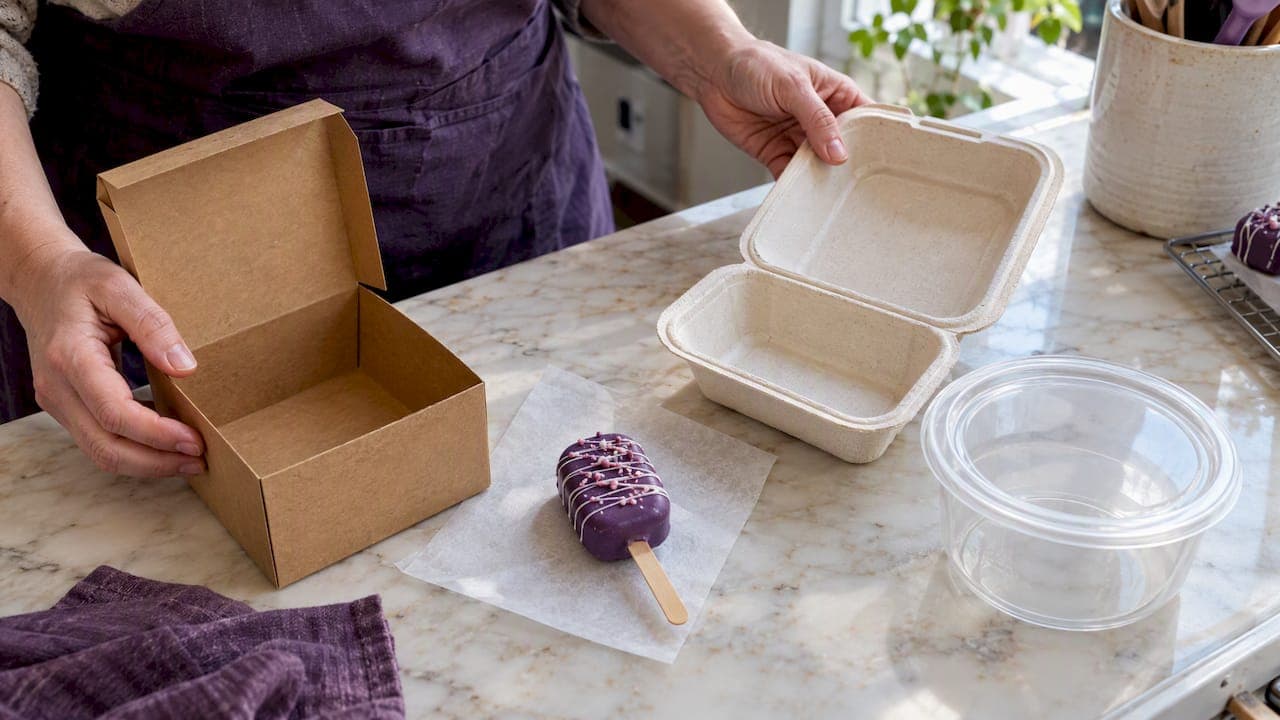
The best practical choices for eco friendly dessert packaging are certified kraft or paperboard boxes, bagasse fibre clamshells, and certified industrial-compostable fibre cups or trays. None of these works well unless you first confirm two things: whether your local system actually accepts or processes that material, and whether it's rated for direct food contact. Skip that check and "eco-friendly" becomes a guess.
TL;DR:
- Confirm whether local waste facilities accept and process the specific eco-friendly material before relying on a label.
- Ensure packaging materials are rated safe for direct food contact, especially for desserts with icing, cream, or oil.
- Test grease-resistant coatings with actual products, as they may prevent composting or recycling.
- Match packaging durability to the dessert's typical handling time to avoid waste from overspecification or damage.
- Request third-party certifications and samples from suppliers to verify claims and suitability for your specific use case.
Table of Contents
- Shortlist: practical packaging types for desserts
- Material comparison: grease resistance, end-of-life, and food safety
- How to choose and what to ask suppliers
- Canadian regulatory and end-of-life realities to factor in
- Typical lifespan and durability in dessert applications
- Design considerations for keeping desserts looking their best
- What eco-friendly packaging adoption looks like for small dessert sellers
- Regulatory compliance beyond the label
- Order fresh, individually wrapped cake pops with thoughtful packaging
- FAQ
- Sources
Shortlist: practical packaging types for desserts
Not every material suits every dessert, and matching the format to the job matters more than chasing a label. Here's a working shortlist of formats you can actually source and use.
- Paperboard windowed boxes: best for cookies, bars, and cake pops where buyers want to see the product before buying, with a cellulose or PLA window that may complicate recycling depending on the window material.
- Bagasse (sugarcane fibre) clamshells: best for slices of cake, pastries, or anything with some moisture, since bagasse holds up to light grease and steam better than plain paperboard.
- Kraft pastry boxes with a grease barrier: best for doughnuts, croissants, and other oily baked goods, though the grease-resistant coating can affect whether the box is accepted for composting.
- Certified industrial-compostable fibre cups or trays: best for puddings, mousses, and parfaits that need a sealed or semi-sealed container, provided your area has an industrial composting facility.
- Reusable deli-style containers: best for repeat customers or catering where a deposit-return system is workable, cutting single-use packaging entirely.
- Compostable cutlery or liners: useful only as an add-on when a dessert needs a spoon or fork, and only where the rest of the packaging is already headed to the same compost stream.
The common thread: a format can look sustainable on the shelf and still be the wrong choice if no facility near you can process it once it's used.
Material comparison: grease resistance, end-of-life, and food safety
Choosing between these materials comes down to how each performs against moisture and grease, what happens to it after use, and whether it's actually approved for touching food.
| Material | Best for | Grease/moisture performance | Food-contact note | End-of-life | Typical price shape |
|---|---|---|---|---|---|
| Kraft paperboard box | Cookies, cake pops, dry baked goods | Low to moderate without a liner | Fine uncoated; coated versions need checking | Recyclable if uncoated; compost varies by coating | Low cost per unit |
| Bagasse clamshell | Cake slices, pastries, moist items | Good, handles steam and light grease | Generally food-safe fibre | Industrial compostable in most cases | Moderate cost per unit |
| Kraft box with grease barrier | Doughnuts, croissants, oily items | Strong | Barrier coating needs supplier confirmation | Often blocked from composting by the coating | Moderate cost per unit |
| Certified compostable fibre cup/tray | Puddings, mousses, parfaits | Good when properly sealed | Check for PLA lining and its food-contact status | Industrial compost only, with certification | Moderate to higher cost per unit |
| Reusable deli container | Catering, repeat customers | Excellent | Food-safe by design, reused many times | Reuse, not single-use disposal | Higher upfront, lower long-term |
Two pitfalls come up again and again. First, compostable plastics and PLA windows look like paper but behave like plastic in a recycling stream: a windowed box with a PLA film can contaminate a batch of paper recycling, and the federal P2 Notice consultation on food plastic packaging notes that recycling symbols are only meaningful where genuine acceptance and processing exist. Second, a grease-resistant coating that makes a kraft box perform better with oily pastries can be exactly what keeps that box out of an industrial composting stream, since many facilities reject coated fibre.
Pro Tip: Call your municipality or regional waste authority directly and ask whether they accept the specific material and format, rather than relying on a package's compostable label; if the answer is unclear or inconsistent, a reusable container is often the safer bet for repeat events.
Industrial compostability certifications such as ASTM D6400 or EN 13432 (or regionally recognized equivalents) are a different claim from "home compostable." Many fibre and bioplastic dessert containers need the sustained heat of an industrial facility and simply won't break down in a backyard bin.
How to choose and what to ask suppliers
A good packaging decision starts with your actual use case, not with whichever option markets itself the loudest.
- Define the use case. Decide whether the dessert needs to survive transport and handling or will only sit on a display table, since transport demands more structural and grease resistance.
- Confirm food-contact safety. Ask whether the material and any coating or lining are rated for direct food contact, especially for anything with icing, cream, or oil.
- Check grease resistance. Request a sample and test it with your actual product rather than trusting a generic description.
- Confirm the end-of-life pathway. Find out if the packaging is recyclable, industrial compostable, home compostable, or reusable, and verify that claim against what your local system accepts.
- Ask about certifications. Request the actual third-party compostability certificate rather than accepting a logo or a general "eco-friendly" claim on faith.
- Request samples before ordering in bulk. A box that looks fine in a photo may fail once it holds a warm or moist dessert for an hour.
When you're talking to a supplier, a short list of questions saves you from greenwashing: Do you have a third-party compostability certificate, and for which standard? Are there any coatings or laminates on this product, and what are they made of? Can I get a sample to test with my own dessert before committing to a minimum order? What is your minimum order quantity and lead time?
On cost, three tactics help: always sample before you commit to volume, stick to standard sizes rather than custom dimensions where possible, and for recurring events consider a reusable deposit-return model, which trades a higher upfront cost for lower cost per use over time.
Canadian regulatory and end-of-life realities to factor in
Environmental claims on dessert packaging aren't just marketing language, they carry legal weight. The Competition Bureau's guidance on environmental claims requires that any "eco-friendly" or "sustainable" claim be evidence-based, specific, and backed by adequate testing or documentation, not a vague gesture toward sustainability.
At the federal level, proposed rules would go further:
- Labelling terms like "compostable" or "biodegradable" may be restricted unless backed by third-party certification to a recognized standard, under the federal pollution prevention notice for food packaging.
- Recycling symbols, including the chasing-arrows triangle, may be limited to packaging with documented, genuinely high rates of local acceptance, not just theoretical recyclability.
- For food-contact applications specifically, Health Canada's guidelines on recycled plastics note that recycled resins are approved for food contact only after a case-by-case safety evaluation, so not every recycled plastic container is suitable even if it's labelled "recycled."
The practical takeaway: a packaging claim is only as good as the paperwork behind it and the system waiting at the other end.
Typical lifespan and durability in dessert applications
Eco friendly packaging doesn't need to last long, it needs to last exactly long enough. A bagasse clamshell holding a cake slice typically needs to stay structurally sound for a few hours between pickup and serving, and it handles that well because bagasse resists bending and light moisture better than thin paperboard. A kraft box without a grease barrier starts to soften within an hour or two if the dessert is warm or oily, which is why bakeries pairing kraft with doughnuts or pastries usually choose a grease-resistant liner.
Certified compostable fibre cups for puddings or mousses are built for single-use, short-term containment: they aren't designed to be washed and reused, and attempting that shortens their already limited structural life further. Reusable deli containers sit at the other end of the spectrum, built to survive repeated washing and handling across many events, which is where their higher upfront cost starts to pay off.
The practical rule is to match durability to the actual window of use. A display box for an afternoon farmers' market has very different requirements than a container that needs to survive a delivery van, a doorstep handoff, and a few hours in a fridge before serving. Overspecifying (using heavy-duty packaging for something consumed within the hour) wastes material; underspecifying risks a soggy box or a leaking tray.
Design considerations for keeping desserts looking their best
Packaging that's good for the planet still has to do its primary job, which is protecting how the dessert looks and tastes until it reaches the table. A windowed paperboard box lets a buyer see decoration detail, piped accents, or a colour theme without opening the lid, but the window material matters: a PLA window keeps that visual clarity while adding a composting wrinkle, while an uncoated cellulose window is easier to recycle but can fog with condensation.
Structural fit matters just as much as material choice. A box or clamshell that's too large lets a dessert slide and smear its decoration during transport, while one that's too tight can crush delicate piped details or disturb a drizzle pattern. For individually wrapped items like cake pops, a snug, individually sized wrapper protects the shape and finish far better than a shared box where pieces can knock against each other.

Colour and finish also interact with packaging choice. A dessert with contrasting colour blocking or a simple drizzle benefits from a container with a clear top or window, since the visual appeal is part of the sale. A heavily textured finish, like sugar crystals or ordinary sprinkles, needs enough clearance inside the container to avoid rubbing off during handling. None of this requires abandoning sustainable materials, it just means choosing the format (clamshell versus flat box versus individual wrap) based on what the specific dessert needs to survive the trip intact.
What eco-friendly packaging adoption looks like for small dessert sellers
Across small and home-based bakeries, the shift toward eco friendly dessert packaging tends to follow a similar pattern: start with the highest-volume, most visible packaging item, confirm it against local disposal realities, then expand from there. A bakery that sells mostly boxed cookies, for instance, often starts by switching from a plastic-windowed box to an uncoated kraft box or a cellulose-windowed version, since that single swap touches the largest share of orders.
For individually wrapped treats such as cake pops, the packaging decision is smaller in scale but still benefits from the same logic: a wrapper or box sized specifically to the product's shape, rather than a generic container, reduces both material use and the risk of damage in transit. A home-based bakery in Dundas, Ontario, wraps each handmade cake pop individually, which keeps the signature rounded-rectangle shape and hand-dipped finish intact from kitchen to table.
The broader lesson from these smaller-scale shifts is consistency: a seller who picks one certified, verified packaging format and sticks with it across products tends to avoid the patchwork of unverifiable claims that comes from switching suppliers or materials every few months chasing the newest "green" label.
Regulatory compliance beyond the label
Labelling claims aren't the only compliance question for dessert packaging. Food-contact safety sits underneath every claim about recyclability or compostability, and it's governed separately. Health Canada's guidance on recycled plastics in food packaging explains that post-consumer recycled plastics are only approved for direct food contact after Health Canada issues a letter of no objection following a case-by-case review, so a package marketed as "made from recycled plastic" isn't automatically safe for direct contact with cake, icing, or cream fillings.
This matters most for materials that combine recycled content with a food-contact surface, such as a recycled-plastic tray lined for a mousse or parfait. A supplier should be able to point to that specific approval rather than a general recycled-content claim. For fibre-based packaging like kraft, paperboard, or bagasse, the equivalent question is about coatings: a grease-resistant or moisture-resistant layer needs to be food-safe in its own right, separate from whether the base fibre is compostable or recyclable.
The practical compliance checklist, beyond checking the compostable or recyclable label, is short: confirm food-contact approval for any recycled content, confirm the safety of any coating or lining, and keep documentation from your supplier on file. None of this requires technical expertise to ask for, only the habit of asking before placing a large order rather than after.

Order fresh, individually wrapped cake pops with thoughtful packaging
If sourcing and vetting dessert packaging on your own feels like more than you want to manage for a birthday, wedding, baby shower, or office event, we offer another route to the same end result: each cake pop from London's Sweets arrives individually wrapped and ready to serve, with the packaging decision already handled as part of the order. We make every cake pop by hand in Dundas, Ontario, in our signature rounded-rectangle shape on a natural wood stick, finished with options like hand-dipped coating, drizzle, sugar crystals, or ordinary sprinkles.
We offer four product lines: Classic Drizzle starting from $42 per dozen, Celebration Sprinkles from $48 per dozen, Signature Mix from $54 per dozen, and a fully Custom Colour Theme from $66 per dozen. For events within roughly 100 km of Dundas, we can arrange paid delivery, though the exact address, timing, and fee need to be confirmed with us before we accept the order. We review every order personally, whether it's for a birthday, a wedding, or a corporate gathering.
If you'd rather hand off the packaging question entirely and focus on the event itself, start by requesting your dozen through our website form and we'll confirm the details with you directly.
FAQ
What's the most practical eco-friendly option for cake pops or small desserts?
Individually sized kraft or paperboard wrapping tends to work best for small, handled items like cake pops, since it protects shape and finish without needing a full box. Always confirm with the supplier whether any coating affects recycling or composting before ordering in bulk.
Is compostable packaging always better than recyclable packaging?
Not necessarily. Compostable packaging only delivers its benefit where an industrial composting facility actually accepts it, and the federal pollution prevention notice notes that claims should reflect real local processing capacity, not just the material's technical compostability.
Can I trust a package that just says "eco-friendly" on the label?
A bare "eco-friendly" claim with no specifics is a red flag under the Competition Bureau's guidance on environmental claims, which requires claims to be evidence-based and specific. Ask the supplier for the certification standard and documentation behind the claim.
Is recycled plastic packaging safe for direct contact with desserts?
Only recycled plastics that have passed a case-by-case safety review are approved for direct food contact, according to Health Canada's guidelines on recycled plastics. Ask your supplier for that specific approval rather than relying on a general recycled-content label.
Does London's Sweets use eco-friendly packaging for cake pop orders?
Each cake pop from London's Sweets is individually wrapped to protect its hand-finished decoration during handling and delivery. Specific packaging materials and any sustainability details can be confirmed directly through our website order form.