
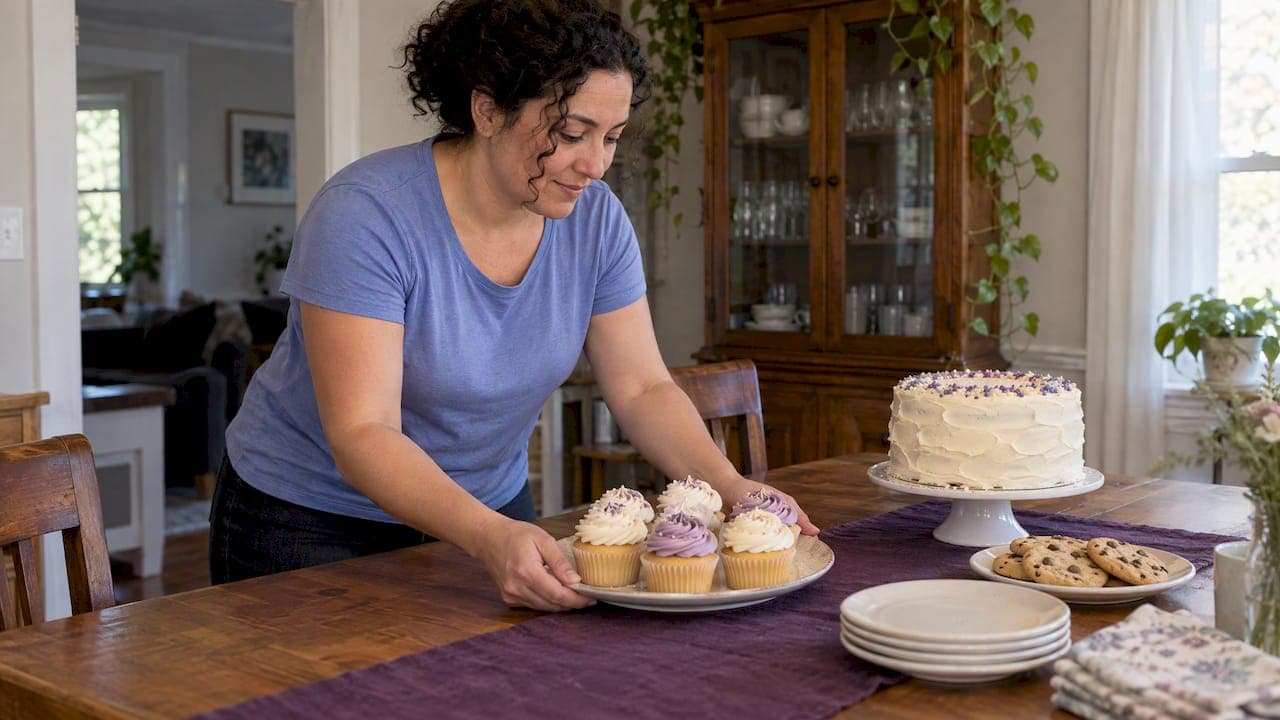
Build your graduation party desserts around a varied spread of one-to-two-bite pieces, which are easier to serve and easier to count. Keep cold items at or below 4°C and hot items at or above 60°C.
TL;DR:
- For 50 guests, plan 100–150 pieces after a meal or 250–400 when dessert is the only sweet, then add a 10% buffer.
- Discard perishable desserts left out beyond 2 hours, or 1 hour at outdoor summer events, and use separate servers to prevent allergen transfer.
- Choose six to eight varieties for parties under 50 guests, or 10 to 12 for more than 100; repeat two school colors across several treats.
- Choose desserts you can prepare ahead, such as mini cupcakes, cake pops, brownies, or cookies, which travel well and need no plates.
Table of Contents
- 1. Which graduation dessert ideas work best for a party?
- 2. How many desserts do you need for your guests?
- 3. What food-safety rules apply to a dessert table?
- 4. How do you style a graduation dessert table?
- 5. Which make-ahead desserts save you the most stress?
- 6. Why do small, individually wrapped sweets help hosts?
- 7. Want ready-made graduation sweets instead of baking?
- 8. FAQ
- Sources
1. Which graduation dessert ideas work best for a party?
The best graduation dessert ideas share three traits: they are small, they can be made ahead, and they look good in your school colours. Here is a shortlist to pick from, with notes on why each earns a spot on the table.
- Mini cupcakes and mini cakes: Count each as one piece, bake them a day ahead, and finish with school-colour buttercream and ordinary sprinkles. Pipe a small dot or swirl on each so the tray looks uniform.
- Cake pops, individually wrapped: Each one is a single clean portion that guests can pick up without tongs. At London's Sweets we make ours in a rounded rectangle on a natural wood stick, finished with hand-dipped coating, simple drizzle, sugar crystals or sprinkles in your colours.
- Mini cheesecakes and no-bake cups: These set in the fridge overnight and go straight onto the table. Top with a berry, a mint leaf or a little crushed cookie. Keep them cold until the moment they are served.
- Brownie and blondie bites: Cut a pan into 2-inch squares and they hold their shape on a platter for hours. A dusting of icing sugar or a small drizzle is enough.
- Petit fours, macarons and mini tarts: These look polished with almost no styling. Buy them from a bakery you trust, then arrange them in rows by colour.
- Chocolate-covered strawberries: They look festive but travel best in a single layer in a shallow container. Dip them the morning of the party and keep them cool.
- Cookie-based handhelds: Sandwich cookies, decorated sugar cookies in a cap shape, or oatmeal rounds travel well and survive a crowd.
- Dessert bars on a tray: Lemon bars, nanaimo-style bars and crispy squares cut cleanly and refill quickly from a sheet pan.
- Ice cream sundae station: Add a few toppings in small bowls and let guests build their own. It is interactive, but it needs cold storage and a helper to keep things tidy.
- Candy jars: Fill glass jars with candies in your school colours. They add height and colour, and they need no refrigeration.
You do not need every item on this list. For a small party, pick six to eight. Hosts often assume that matching the school colours means custom shapes or complicated decorating, but simple finishes do the job: a coloured coating, a drizzle, a sprinkle blend or a row of small piped dots. Repeating one colour across three or four different desserts ties the table together faster than any single showpiece.
Cake, cupcakes and cookies are the safest bets if you are unsure what your guests prefer. They are familiar, easy to eat standing up, and they suit both children and grandparents. If the party runs long, add one cold dessert and one warm-weather-friendly option so the table has something for every hour.
If you are weighing similar mini options for another celebration, our engagement party desserts post shows how cake pops sit alongside other small custom treats on a menu.
2. How many desserts do you need for your guests?
Count pieces, not desserts. Industry planning standards that Health Canada's holiday food safety guidance is paired with in event planning say to allow 2–3 mini pieces per guest after a meal, 4–6 if the dessert table is the main sweet, and 5–8 for a dessert-only reception. A mini piece is roughly one to two bites: a cake pop, a mini cupcake, a 2-inch brownie square, a macaron or a small cheesecake cup.
Use these steps to turn that into a shopping or baking list:
- Pick your per-guest number. Use 2–3 pieces after a full meal, 4–6 if dessert is the main sweet, 5–8 for dessert-only.
- Multiply by your guest count. Count children as full adult portions.
- Add a 10% buffer. This covers appetite variation and late arrivals.
- Count full-size items as two pieces. A standard cupcake or a plated cake slice counts double.
- Convert to dozens or pans. Divide your piece total by 12 for dozens, or by the number of squares a pan yields.
Here are worked examples using the after-meal range of 2–3 pieces per guest:
- 25 guests: 50–75 pieces, so about 55–83 with the buffer.
- 50 guests: 100–150 pieces, so about 110–165 with the buffer. In a dessert-only setting, the same group needs 250–400 pieces.
- 100 guests: 200–300 pieces, so about 220–330 with the buffer.
Say you are hosting 50 guests after a sit-down lunch and want eight varieties. At roughly 2.5 pieces per guest, plan about 138 pieces with the buffer, or around 18 of each variety. Rounding up to two dozen of the most popular two or three items makes the table look generous without waste.
For a fuller illustration of counts at a specific party size, our anniversary dessert plan for 20 guests walks through the same math with cake pops.

3. What food-safety rules apply to a dessert table?
A buffet-style dessert table is safe when you control temperature and time. Health Canada guidance via Indigenous Services Canada says to keep cold desserts at or below 4°C and hot desserts at or above 60°C. The range between 4°C and 60°C is the danger zone, where bacteria multiply fastest.
You cannot tell whether food is safe by looking at it, smelling it or tasting it. That is why timing matters more than instinct:
- Two-hour limit: Perishable desserts left at room temperature for more than 2 hours should be thrown out. At an outdoor summer event, the window shortens to 1 hour.
- Dedicated tools: Give every dessert its own tongs, spatula or server so flavours and allergens do not cross over.
- Fresh platters, not top-offs: Replace a used platter with a fresh one instead of piling new pieces on top of old ones.
- Individually wrapped items: Wrapped pieces mean fewer hands on food and a simpler cleanup.
- Allergen labels: Health Canada's food guide teaching resource recommends checking dietary restrictions ahead of time and keeping safe, labelled alternatives for guests with allergies. Talk to parents or guardians about children's needs.
- Shelf-stable or professionally handled choices: When you are unsure, favour desserts that do not need constant refrigeration.
Refrigerated baked desserts are ready to eat and convenient, but they have been linked to recalls and outbreaks. A Canadian Food Inspection Agency survey found that most retail samples tested were safe, and it still recommends safe handling for producers, retailers and consumers. For you, that means keeping cheesecakes, trifles and cream-filled items in the fridge until they are served.
Pro Tip: Set out small platters and keep the rest chilled, then swap in a fresh tray regularly. The table stays full, and nothing sits out longer than it should.
For a deeper look at themes and safe serving, see our dessert table setup guide.
4. How do you style a graduation dessert table?
A dessert table looks abundant because of repetition and consistent portion size, not because of raw volume. Planning guidance paired with the Health Canada holiday food safety page suggests 6–8 varieties for parties under 50 guests and 10–12 for more than 100 guests. Too many different desserts means constant restocking, and the table starts to look patchy.
- Repeat your colours: Pick two school colours and use them on three or four items: sprinkles on cupcakes, drizzle on cake pops, a coloured coating on pretzels.
- Build height: Use cake stands, small boxes under a cloth, or books wrapped in paper to create levels. Place tall items at the back.
- Group by colour or type: Rows of the same dessert look intentional. Mixed piles look messy.
- Keep portions the same: The two-bite standard matters more than variety. Guests relax when everything is the same size.
- Put popular items at the front: Place easy grab-and-go pieces where guests arrive, and leave a clear path so people do not crowd.
- Use tongs on crushed ice for cold items: A shallow tray of ice keeps mini cheesecakes and fruit cups cool while they are out.
- Choose wrapped pieces when you want minimal handling: Individually wrapped cake pops or small favour-style bags can sit in a basket without any serving tools.
For colour inspiration, the vibrant food presentations collected by Wild Foodz show how bold, bright plating draws the eye. You can borrow the same idea with colour blocking: one colour per tray, repeated down the table.
5. Which make-ahead desserts save you the most stress?
The easiest graduation party desserts are the ones you finish ahead of time and only plate on the day. Pick recipes that are chilled, layered or baked in a single pan, and you will spend the party with your guests rather than in the kitchen.
- No-bake mini cheesecakes: No-bake maple leaf mini cheesecakes are made in muffin tins and chilled until set. Swap the topping for berries to suit your school colours.
- Cheesecakes with a branded mix-in: KitKat mini cheesecakes from Nestlé Professional show how a familiar candy lifts a simple mini cheesecake.
- Raspberry swirl cheesecakes: Dairy Farmers of Ontario published a mini raspberry swirl cheesecake recipe that works as an elegant bite-sized dessert for an occasion like this.
- Mini trifles: Mini trifles come together quickly with prepared pudding or mousse layered in small glasses and finished with berries or mint.
- Brownie bites: Bake a day ahead, cut into 2-inch squares, and store in a covered container until the party.
Keep every chilled item in the fridge until service, and do not leave perishable pieces at room temperature beyond the safe window described above. If you would rather skip the baking, we can handle part of the table: our cake pop bouquet ideas post shows how wrapped cake pops can be displayed with food safety in mind.
6. Why do small, individually wrapped sweets help hosts?
Event planners point to small, individually portioned items as a reliable way to make a table look generous while keeping service simple. Planning guidance tied to Health Canada's seasonal food safety resources notes that guests can sample several flavours when each piece is a bite or two, and that consistent portion size matters more than a huge variety.

Wrapped sweets suit that approach. We make handmade cake pops in a rounded-rectangle shape on a natural wood stick, and each one is individually wrapped. Our lines are Classic Drizzle, Celebration Sprinkles, Signature Mix and Custom Colour Theme. Paid delivery may be requested within approximately 100 km of Dundas, and we confirm the address, timing, availability and fee before accepting any order. To ask about colours or custom requests, start at Londonsweets, and confirm your date early.
7. Want ready-made graduation sweets instead of baking?
If you would rather order than bake, we make small-batch cake pops that fit a graduation table in your school colours. Each one is handmade, individually wrapped and finished simply.


- Classic Drizzle: from $42 per dozen.
- Celebration Sprinkles: from $48 per dozen.
- Signature Mix: from $54 per dozen.
- Custom Colour Theme: from $66 per dozen, matched to your colours.
Every cake pop has our signature rounded-rectangle shape on a natural wood stick. Delivery is paid, and availability and fees are confirmed per order through our delivery page. Request your quote through the order form on our website and we will confirm your date, design and delivery details with you.
8. FAQ
How many mini desserts do I need for 50 guests?
Plan 100–150 pieces after a meal, or 250–400 pieces for a dessert-only party, based on Health Canada-linked planning guidance.
What type of food is good for a graduation party?
Choose small, easy-to-eat desserts that need no plates: mini cupcakes, cake pops, brownie bites, cookies and mini cheesecakes. Pick six to eight varieties for under 50 guests and keep portions consistent.
How long can desserts sit out at a graduation party?
Perishable desserts should not stay at room temperature for more than 2 hours, and the window drops to 1 hour at outdoor summer events, according to Indigenous Services Canada food safety guidance. Replace used platters with fresh ones.
What do you write on a graduation cake?
Keep it short: "Congratulations, [Name]!", "Class of [year]" or "Well done, graduate." Add the school name or colours with simple piped lettering.