
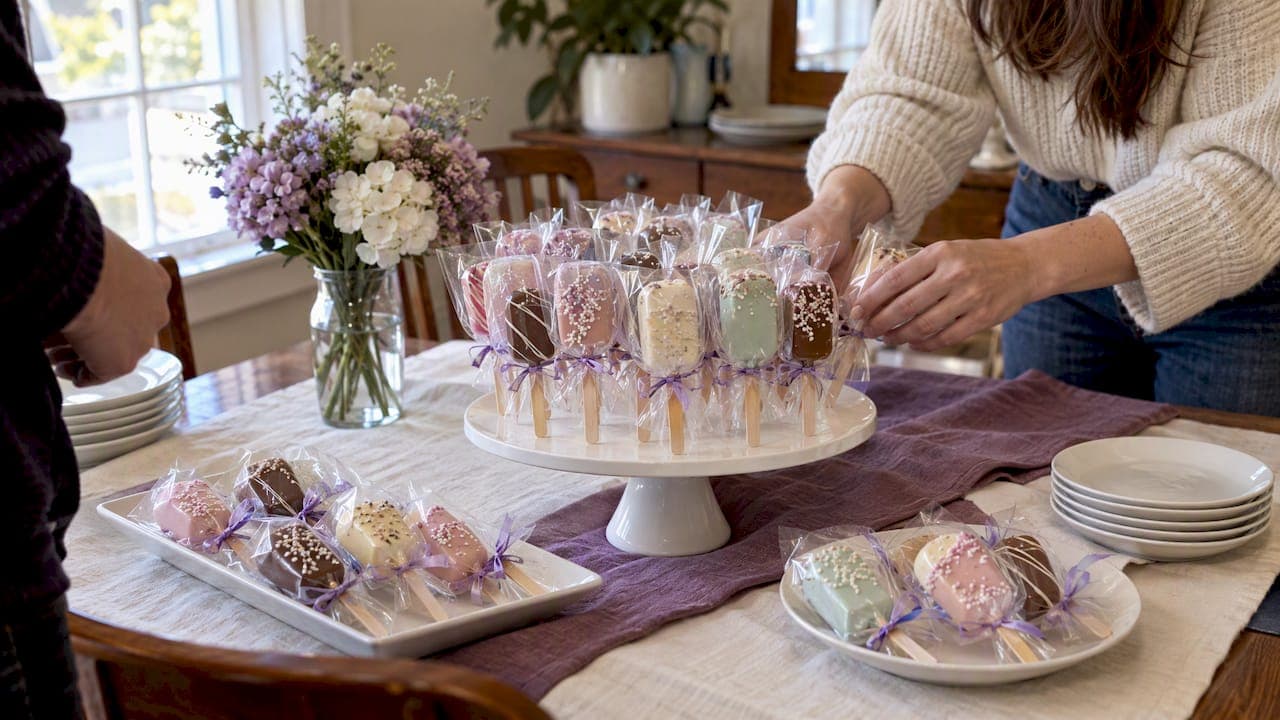
A dessert table setup succeeds when three things line up: a clear visual theme, layered height, and safe self-serve habits. Rustic crates, tiered stands, or a pastel palette all work, as long as the layout guides guests smoothly and food stays at safe temperatures. Individually wrapped handheld treats, such as cake pops, fit neatly into almost any of these setups because they travel well and need no serving utensils.
TL;DR:
- Keep perishable desserts out of the 4°C to 60°C danger zone, and discard any left out for more than two hours.
- Place the table where guests can approach from one side and leave from another, with a clear view from the main gathering area.
- Use two or three colors, repeat the palette and materials at least twice, and group small desserts in clusters of three or five.
- Individually wrapped cake pops need no serving utensils and remain sealed until picked up, making them useful as buffet desserts or favors guests can carry away.
- Paid delivery may be available within roughly 100 km of Dundas; timing and fees are confirmed before London’s Sweets accepts an order.
Table of Contents
- Five dessert table themes to borrow for your next event
- Setting up the table: placement, flow, and height
- Keeping a self-serve dessert table food-safe
- Styling details that make the table look finished
- Where cake pops fit on a dessert table
- Ordering cake pops from London's Sweets
- FAQ
- Sources
Five dessert table themes to borrow for your next event
A good theme gives every other decision, from linens to labels, a reason to exist. These five groupings are flexible enough for a backyard party or a full wedding reception, and each one works because it repeats a palette or material instead of mixing too many ideas at once.
- Rustic: wooden crates at different heights, kraft paper signage, and glass jars filled with cookies or mini tarts.
- Elegant tiers: matching white cake stands in three heights, macarons, petite cakes, and small metallic accents like gold cake toppers.
- Candy buffet: clear glass jars with labelled scoops, and wrapper colours that repeat two or three shades instead of a rainbow.
- Pastel party: cupcakes and cake pops arranged against a soft backdrop with matching bunting.
- Modern minimalist: a monochrome palette, generous negative space, and geometric stands instead of ornate ones.
Whichever theme you pick, three styling rules hold true across all of them. Group small items in odd numbers (three or five) rather than even ones, since clusters of odd numbers tend to read as intentional rather than leftover. Give the table one clear focal point, whether that's a tiered cake or a tall bouquet of cake pops in the centre. Repeat your chosen colours and materials at least twice so the table feels planned rather than assembled from whatever was on sale.
Setting up the table: placement, flow, and height
A dessert table needs to work logistically before it can look good. Start with where it sits in the room, then build height and grouping on top of that foundation.
- Choose placement for flow: set the table where guests can approach from one side and exit from another, avoiding a dead-end that creates a lineup.
- Check sightlines: make sure the table is visible from the main gathering area so it draws guests naturally.
- Build height in layers: use cake stands, sturdy boxes, or crates as risers, and make sure anything holding food is stable and food-safe.
- Group by type: cluster cookies together, cupcakes together, and handheld items like cake pops together, so guests can scan the table quickly.
- Label clearly: small cards naming each item and flagging common allergens help guests make quick decisions.
- Plan for refills: swap in a fresh tray rather than topping up an existing one, since mixing new and old portions on the same plate increases contamination risk.
A short equipment list keeps the setup running smoothly once guests arrive:
- Tongs and extra serving utensils for each dish.
- A probe thermometer to spot-check hot or cold items.
- An ice bed or chilled tray for anything perishable.
- A sneeze guard for larger or longer events.
- Plenty of napkins and a stack of clean plates near the start of the table.
Keeping a self-serve dessert table food-safe
Dessert tables are buffet-style service, so the same temperature rules that apply to savoury buffets apply here too. Perishable items should never sit in the temperature danger zone of 4°C to 60°C for more than two hours, according to Health Canada's holiday food safety guidance, which also recommends discarding anything left out longer than that and using warming trays or crushed ice to hold temperature.
A few habits make this manageable even for a small home gathering:
- Give every dish, including finger foods, its own serving utensil rather than relying on guests' hands.
- Use probe thermometers to confirm cold items stay at 4°C or colder and hot items at 60°C or hotter, swapping in ice or a warming source as needed.
- Assign one person to keep an eye on a larger self-serve station, and put up simple signage asking guests to use the tools provided, a practice outlined in this buffet food safety guide.
For a small backyard party, this scales down to little more than keeping desserts in the shade, swapping trays every couple of hours, and setting out tongs instead of letting guests dig in with their hands.
Styling details that make the table look finished
The difference between a table that looks staged and one that looks thrown together usually comes down to a handful of small, repeatable choices rather than an expensive overhaul.
- Signage: use a readable font, keep allergy notes short and visible, and place cards at the front edge where guests will actually look before reaching for food.
- Lighting: a few small lamps or dimmed string lights add warmth, and a mirrored tile under a stand can add depth without extra clutter.
- Props: thrifted stands, rented risers, or a linen sized to the table's actual width stretch a budget further than buying everything new.
- Restraint: limiting the palette to two or three colours and leaving some negative space reads as more deliberate than filling every inch.
Pro Tip: Arrange small items like macarons or cake pops in clusters of three or five rather than even numbers; it's a small shift that makes the grouping look intentional instead of random.
Where cake pops fit on a dessert table
Individually wrapped cake pops slot into almost any layout because they don't need a serving utensil and guests can take one without touching anything else on the table. Each cake pop is shaped as a rounded rectangle on a natural wood stick, which sits upright in a stand more steadily than a round shape would.
- Tiered stands: upright pops in a holder work as a mid-height layer between taller cakes and low jars.
- Favour bundles: small grouped clusters near the exit double as a dessert and a takeaway gift, a layout we've detailed in our cake pop bouquet ideas.
- Focal bouquets: a tall jar of pops arranged like a bouquet gives the table a centrepiece without needing a full cake.
- Late-night stations: a simple stack works well for late-night wedding snacks when guests want something quick to grab.
Individual wrapping also simplifies hygiene on a self-serve table, since each piece stays sealed until a guest picks it up.
Ordering cake pops from London's Sweets
Four product lines are made, each handmade in small batches, so you can match a dessert table's palette without compromising on the finish. Orders go through a website form, and each request is reviewed personally before confirming it.

Paid delivery can be requested within approximately 100 km of Dundas, Ontario, though the exact address, timing, and fee are confirmed with you before we accept the order. For larger events where refrigerated holding matters, a climate-controlled rental unit is worth considering alongside your dessert table plan.
- Browse our product lines and ordering details to start a request.
- Check delivery details for the Dundas area before confirming your date.
- See our wedding favour page if cake pops are doing double duty as a favour and a dessert.
FAQ
How do I set up a dessert table?
Start by planning the table's placement for easy guest flow, then build height using stands, boxes, or crates before grouping desserts by type. Add labels for each item, keep high-risk foods out of the 4°C to 60°C danger zone, and plan to refill with fresh trays rather than topping up used ones.
What should a dessert table include?
A well-rounded table usually includes a mix of textures: something baked (cookies or tarts), something layered (cupcakes or petite cakes), and a handheld item like cake pops that guests can take without a plate. Signage noting allergens and clear labels for each dessert round out a functional setup.
What are the 5 C's of dessert?
There's no single, widely recognized definition of "the 5 C's of dessert" in food-safety or culinary sources, so treat any version you see as informal shorthand rather than an official standard. If you're looking for setup guidance, focus instead on theme, height, grouping, labelling, and food safety, the elements covered throughout this guide.
Are dessert tables still in style?
Dessert tables remain a common feature at weddings, showers, and parties because they give guests a visual focal point and a variety of options in one place. Styles shift over time, from elaborate tiered displays to simpler, minimalist setups, but the format itself continues to show up at events of every size.